A story of courage, determination and freedom — breaking barriers in a male-dominated era of aviation.
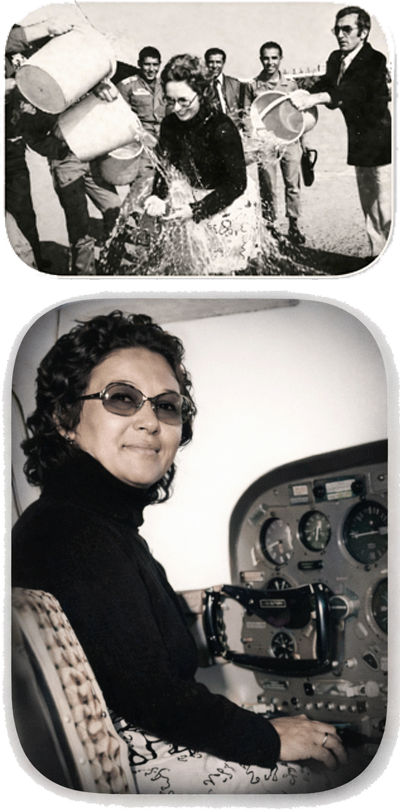
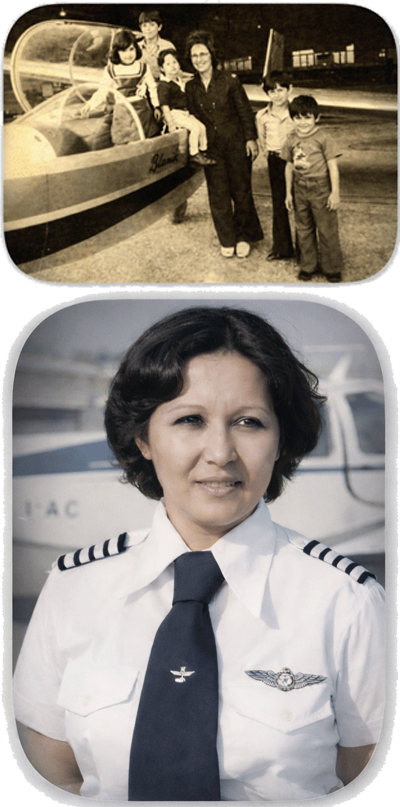
In 1974, Akram Monfared Arya began her flight training in Iran while raising five children. At a time when aviation was almost exclusively male-dominated, her decision to enter the cockpit was both bold and unconventional.
Choosing to pursue aviation was not merely a professional ambition - it was an act of conviction. In a society where expectations for women were clearly defined and limited, she chose to challenge tradition and follow her passion for flight.
Her aviation journey began with glider training, where she earned her glider pilot certificate. The silent discipline of gliding demanded focus, precision and trust in the forces of nature - qualities that would later define her approach to both life and art.
She continued her training with single-engine aircraft and later twin-engine airplanes, demonstrating remarkable dedication and technical proficiency.
Apart from Princess Fatemeh Pahlavi, she became one of the first women in Iran to obtain a full pilot’s license - a milestone that symbolized courage, independence and determination.
For her, flying represented far more than mastering an aircraft. It was a declaration of freedom. It was proof that boundaries - whether social, cultural or psychological - could be crossed.
The cockpit became a space where expectations dissolved and capability defined identity. In the sky, there were no imposed limitations - only altitude, direction and possibility.
Her aviation career continued until the Islamic Revolution in 1979. The political upheaval that followed brought civilian flying activities to a halt, abruptly ending her time in the air.
Shortly thereafter, she left Iran and eventually rebuilt her life in Sweden. Like many who were forced into exile, she carried both loss and resilience with her - but also the memory of flight.
Although her active flying career was interrupted, the spirit of aviation never left her. Flight became a powerful metaphor that would later define her writing, artistic expression and life philosophy.
The experience of navigating open skies, reading invisible currents and trusting one’s own judgment became symbolic of a larger truth: that freedom is both an external condition and an internal state of mind.
Her story remains a testament to courage, perseverance and the enduring human desire to rise above limitations - and to keep flying, even when grounded.